 Nordic Gradient
The problem
A camera placed in the Nordic countryside should tell which animal passes by: boar, elk, moose, roe deer or fox, or one of the pets, cat and dog. It runs on a Raspberry Pi 3, a cheap computer with low power use, instead of a heavy GPU setup.
The Pi runs the model on its processor, where even the smallest YOLO model needs seconds per picture. That settles the model before any training starts: YOLO26n, the nano version, at 640 pixels. A larger model or a higher resolution is not an option, so every gain has to come from the data.
The approach
A first prototype in one line
Before collecting any data, the simplest thing to try is a pretrained YOLO26n, downloaded and run as it is:
YOLO("yolo26n.pt").predict(frame, conf=0.40)The real test is 18 animals from my own camera, labeled by hand from about six visits: 9 moose, 6 roe deer and 3 foxes. They are never used for training. COCO, the data it was trained on, has cat, dog, horse, cow and bear, but no moose, deer or fox. It finds 13 of the 18 animals and names none of them correctly: moose become horses, roe deer and foxes become dogs.
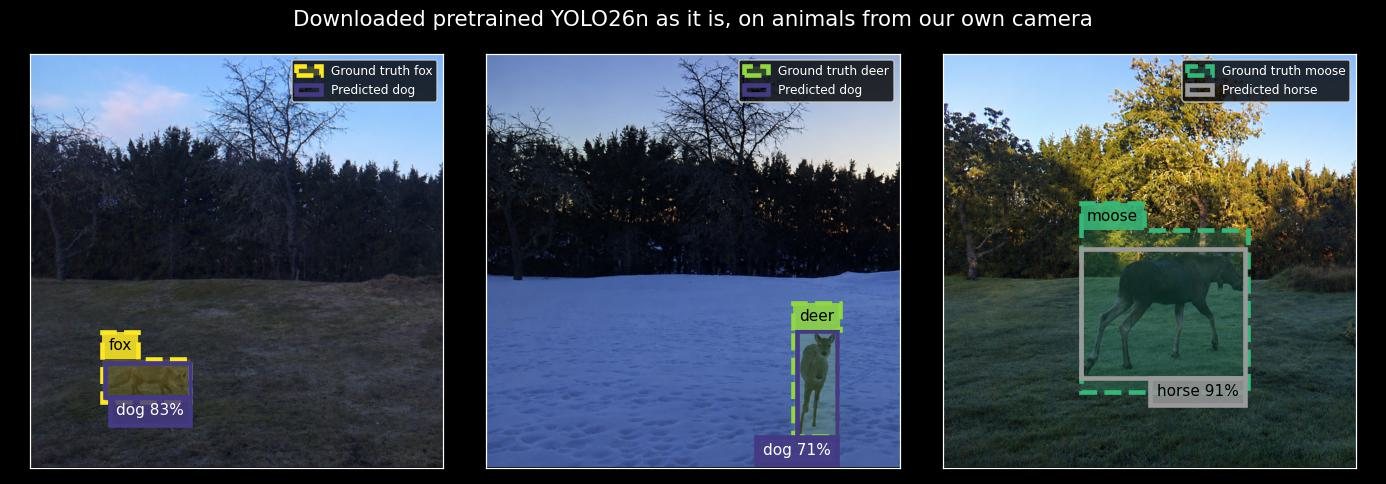
If all I wanted was to catch the moments when an animal passes, this would almost do. To tell a moose from a roe deer, the model has to be fine-tuned on these classes.
The data, and what was wrong with it
The training data combines cats, dogs and birds from COCO with wildlife datasets from Roboflow: trail camera pictures of elk, moose, roe deer and boar, many of them infrared night shots, and ordinary daytime photos of boar and fox. All layers of the model are trained, since trail camera pictures look different from COCO photos. Two problems in the data had to be fixed first.
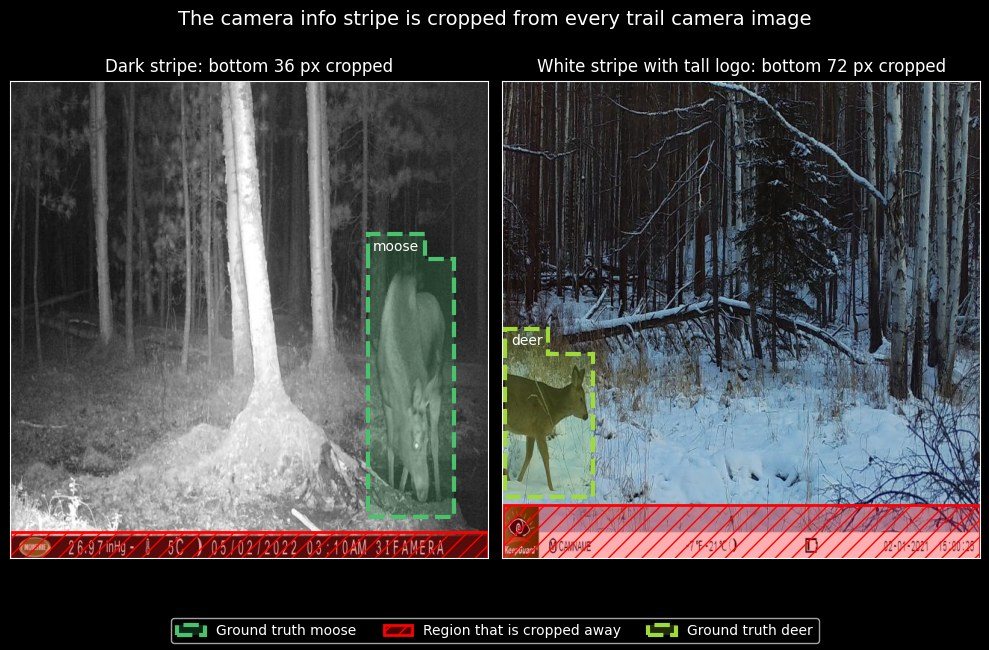
The camera stripe gives away the answer. Trail cameras stamp a stripe with a logo at the bottom of every picture, and no other class has it. A model can learn “stripe means elk, moose or deer” instead of looking at the animal. The stripe is cropped from every such picture, by an amount found for each one.
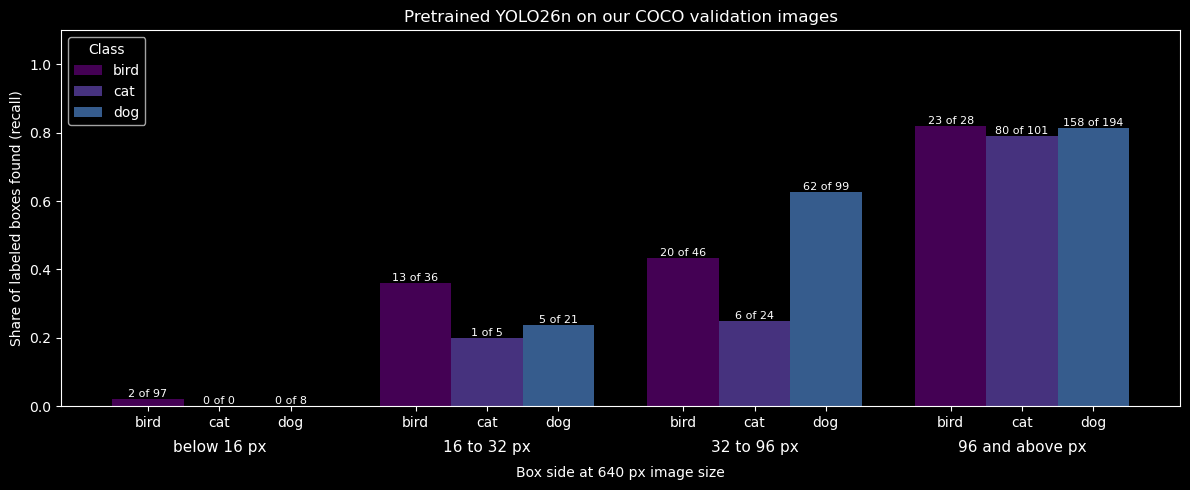
Some animals are too small for a nano model. Run on my COCO validation pictures before any training, the pretrained model finds 2 of 97 bird boxes below 16 pixels, and 23 of 28 at 96 pixels and above. It has already seen all of COCO, so more data would not change that. COCO pictures with any box below 32 pixels are removed, and bird is dropped as a class.
A good test score, and every animal a dog
The first fine-tuned model looks good on its test set, with a precision of 0.89, a recall of 0.78 and an F1 score of 0.83. On my own camera it finds 14 of the 18 animals, one more than the pretrained model, but still names none of them correctly. It calls every one of them a dog.
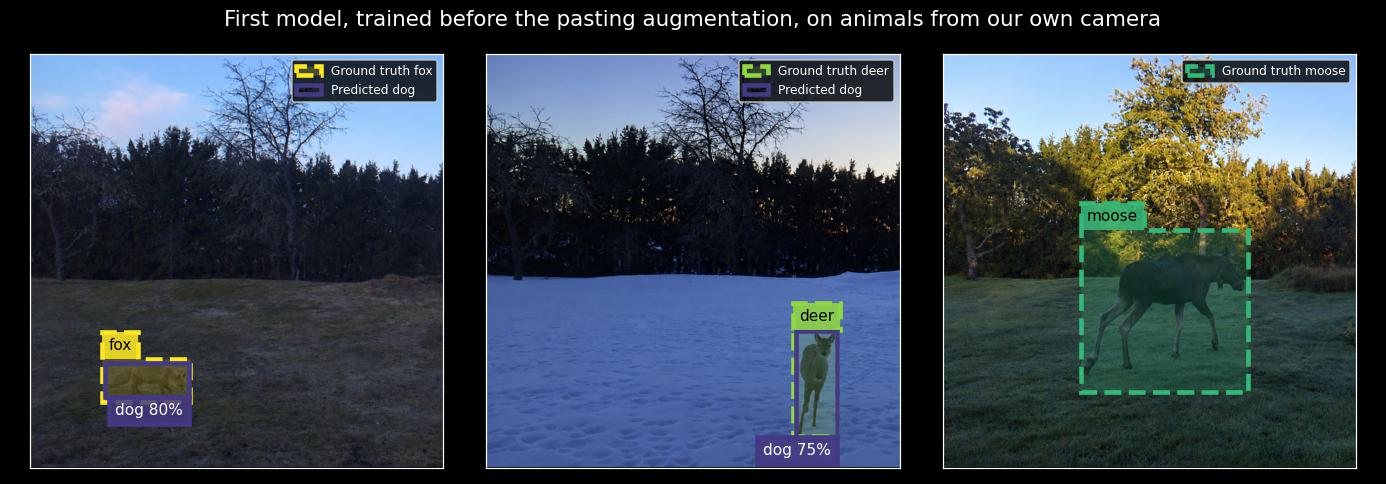
The reason is the size of the animals. My camera looks out over an open lawn, where a roe deer or a fox covers 1 to 2% of the picture. The wildlife photos show animals at close range. In the training data a wild animal rarely covers less than 2% of the picture, while small dogs are common, so the model learned “a small animal in a wide scene is a dog”. The test set comes from the same sources as the training data, so it could not show this.
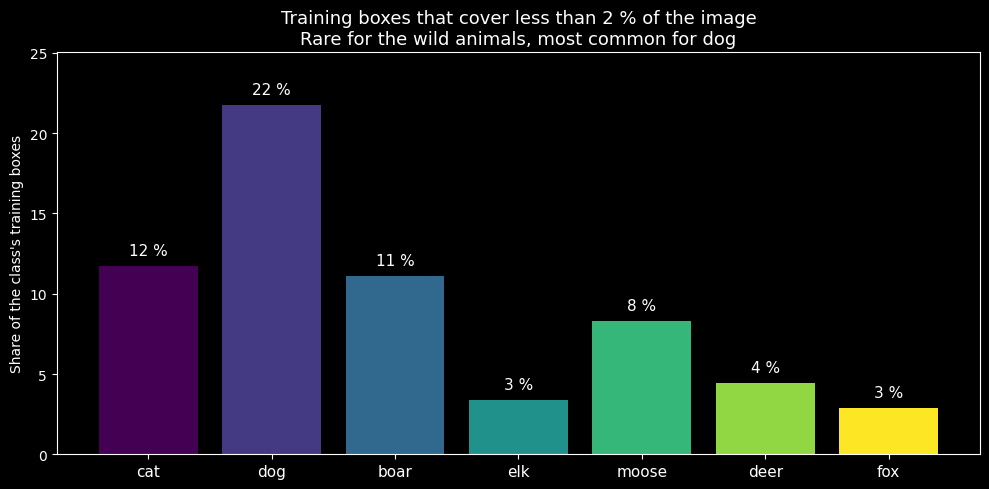
Segmentation pasting into my own scenes
The remedy is to paste animals from the training set, small, into empty pictures from my camera. A segmentation model, MobileSAM, turns the box around an animal into its outline, so no rectangle of forest comes along. The pasted size follows the place and the species: further up the lawn is further away and smaller, and at the same place a moose is about twice as tall as a roe deer. Some empty pictures are added unchanged, as scenes without any animal. The figure shows the same steps on public training pictures.
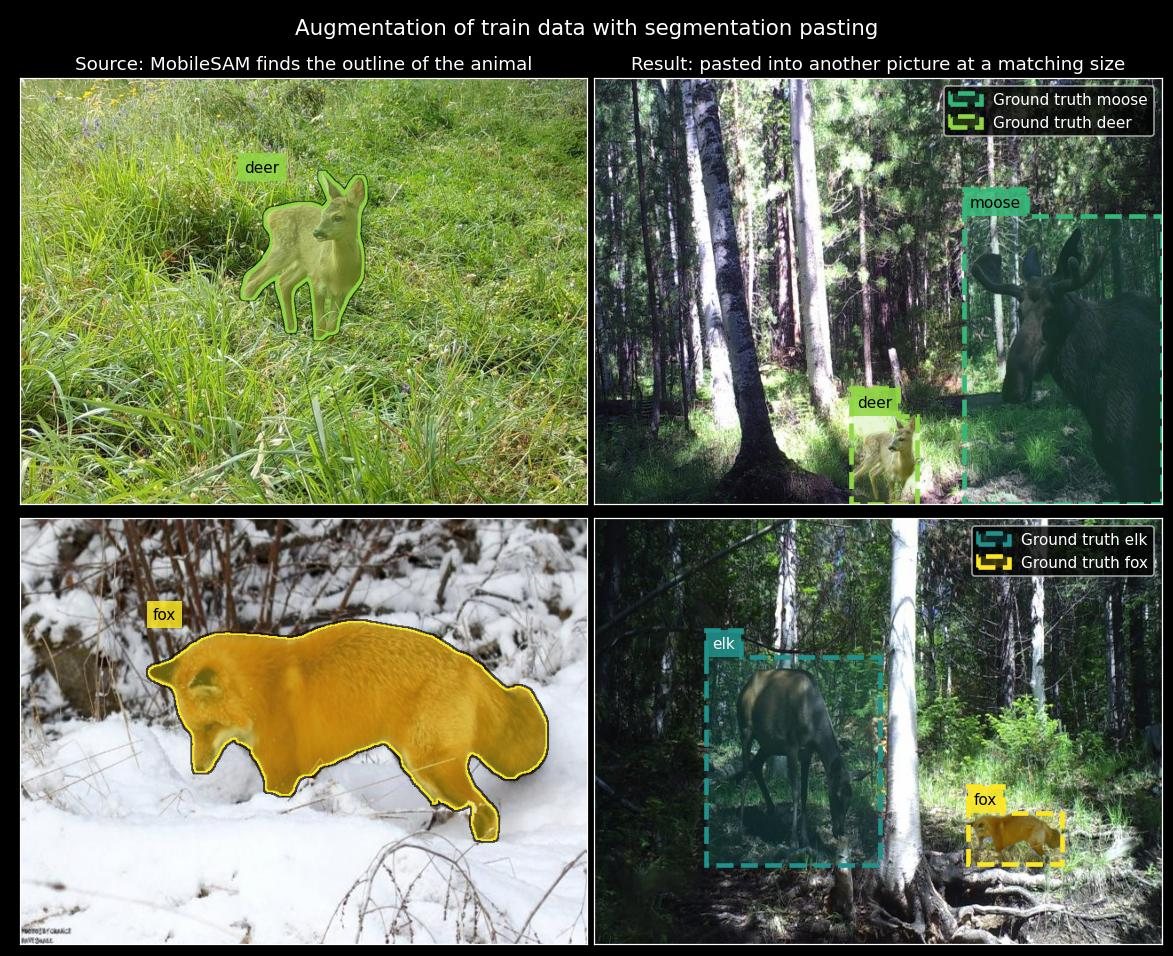
Two more datasets fill the gaps the camera test showed: moose in daylight, where the other moose are mostly gray infrared shots, and roe deer, fox and boar from Italian trail cameras.
Results
On the test set the final model gains a little on the first one. Each runs at the confidence threshold that gives its best F1 score on the validation set, 0.40 for the final model:
| Model | Precision | Recall | F1 score |
|---|---|---|---|
| First model | 0.89 | 0.78 | 0.83 |
| Final model | 0.90 | 0.84 | 0.87 |
On my own camera the difference is large. The final model names 16 of the 18 animals correctly: all 3 foxes, all 6 roe deer and 7 of 9 moose. One moose is called a roe deer, and one, of which only the legs show at the edge of the picture, is missed.
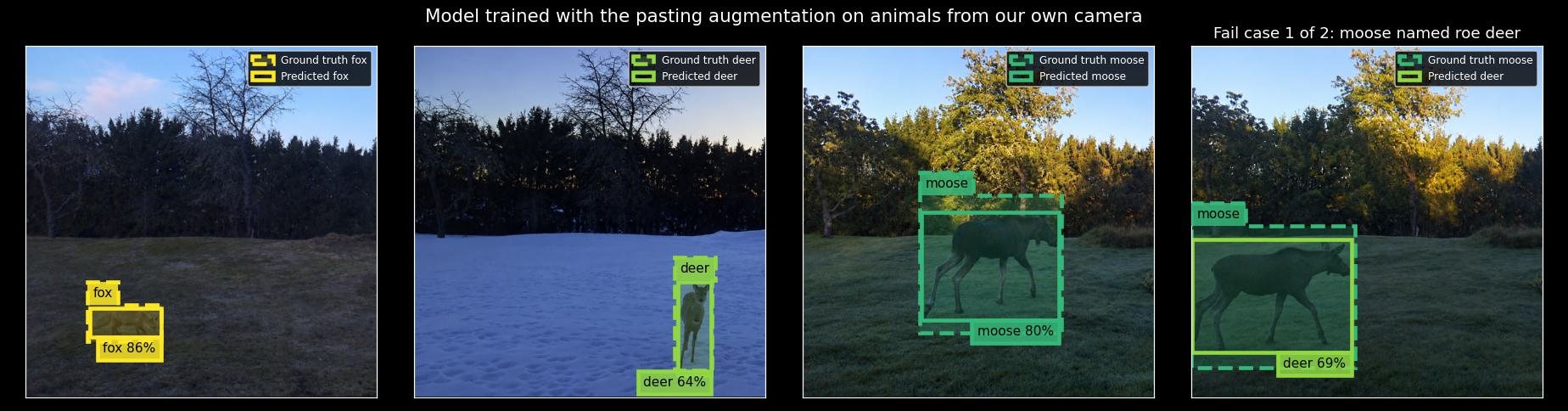
Most of the time my camera sees no animal at all, and a model that sees animals there is of little use. So the test also has 108 pictures from my camera without any animal, never used for training. All three models run at 640 pixels and a threshold of 0.40:
| Model | Animals found | Animals named correctly | Empty scenes left empty |
|---|---|---|---|
| Pretrained YOLO26n | 13 of 18 | 0 of 18 | 108 of 108 |
| First model | 14 of 18 | 0 of 18 | 105 of 108 |
| Final model | 17 of 18 | 16 of 18 | 108 of 108 |
The final model finds and names the animals without seeing animals where there are none. On the test set, the wild animals are almost never mistaken for each other.
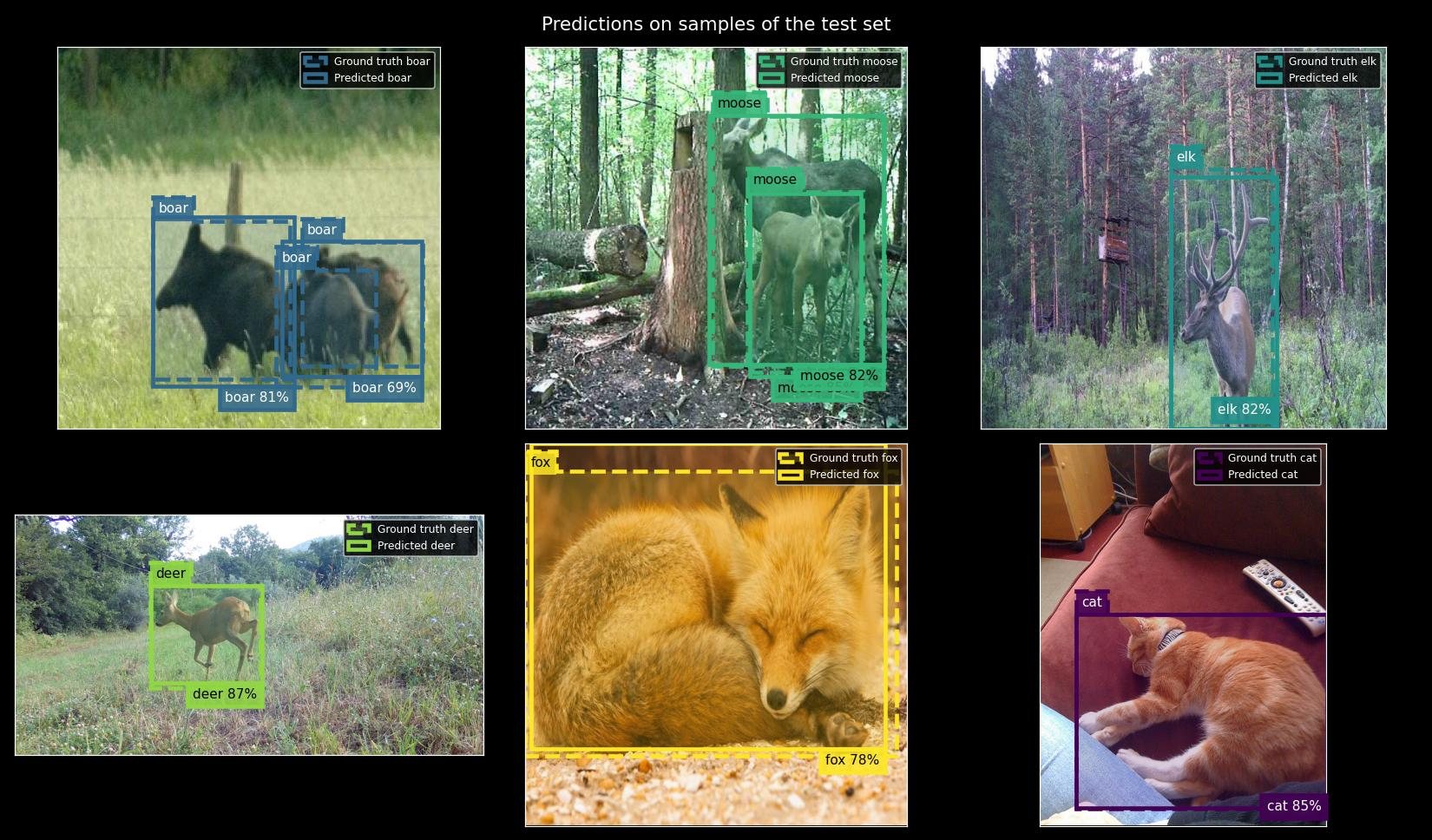
Where it fails
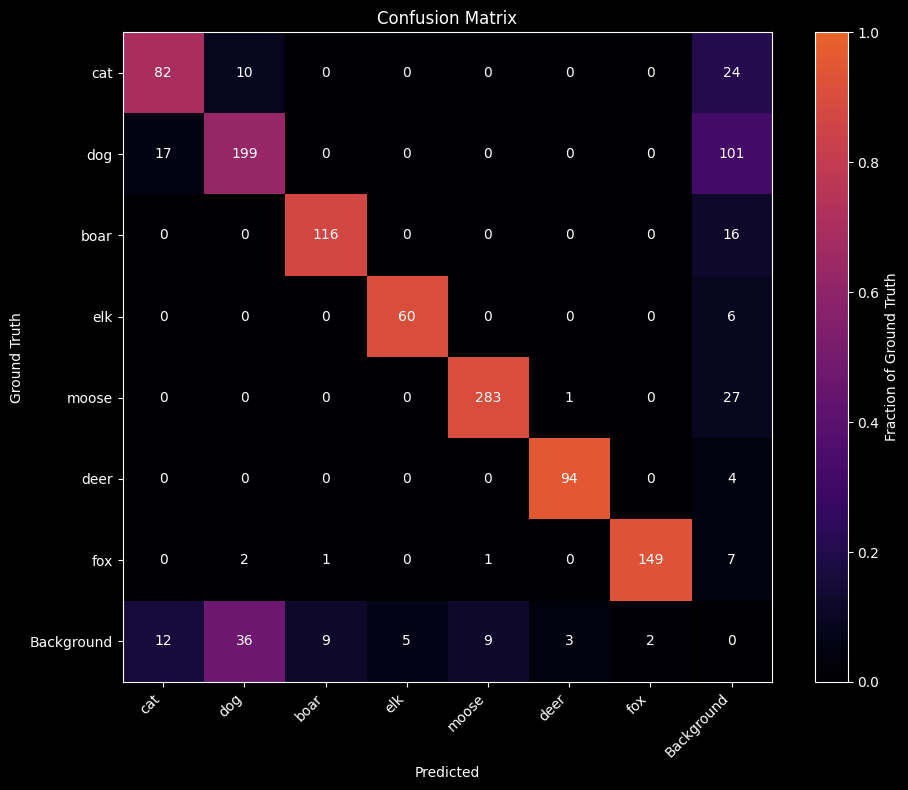
Cats and dogs are the weak spot on the test set. The model mixes them up, with 10 cats called dogs and 17 dogs called cats, which matters little here, since both are pets. More often it misses them entirely: 24 of 116 cats and 101 of 317 dogs are not found. Of the wild animals, 27 of 311 moose and 16 of 132 boar are missed, and elk, roe deer and fox only rarely.
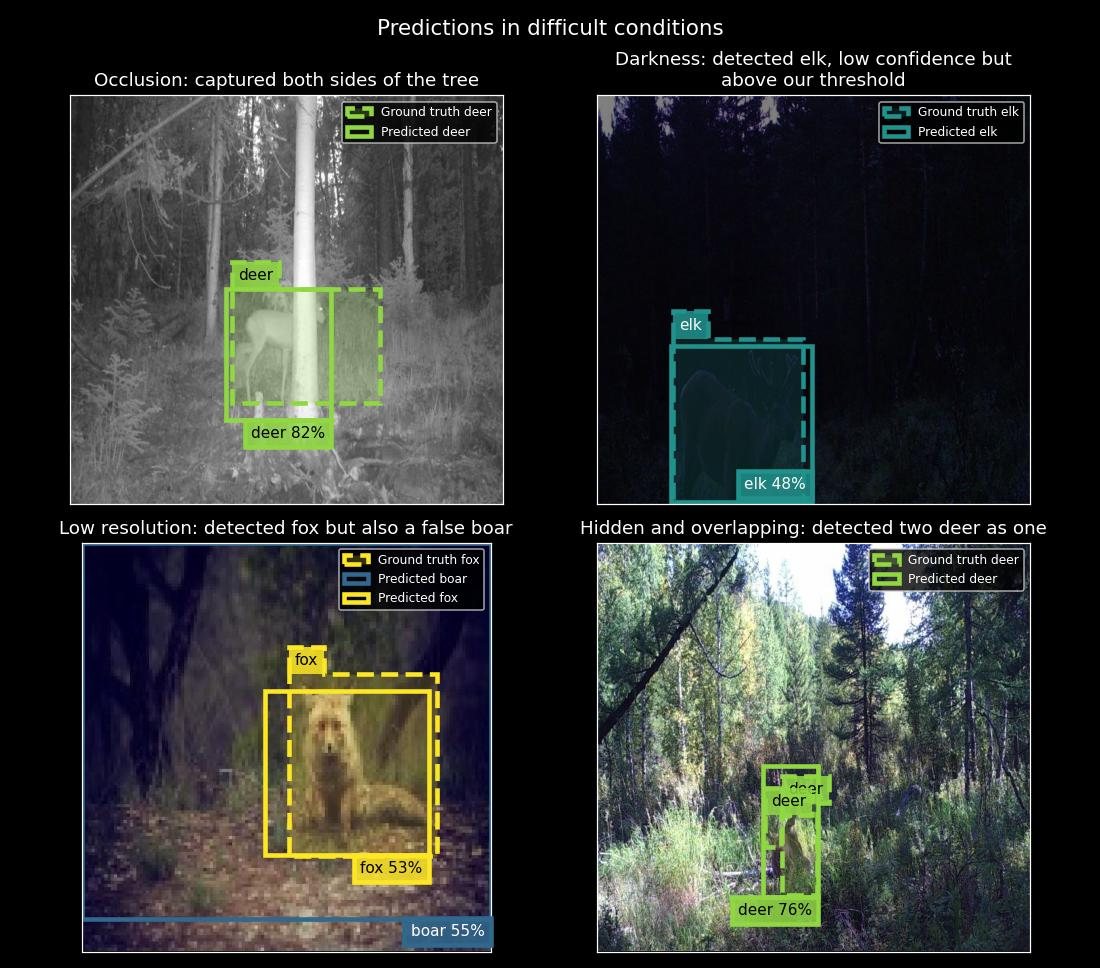
Hard pictures show where the limits are. The model keeps a roe deer whole on both sides of a tree, and finds an elk at night at 48%, low but above the threshold. In a blurry low-resolution frame it finds the fox but also a boar across almost the whole picture, and two roe deer that overlap in the vegetation become one.
And there are known limits:
- On the Raspberry Pi 3 the model takes about 2 seconds per picture, so an animal that passes quickly is seen in few pictures or none.
- The trail camera pictures in training and test come from the same camera locations. The scores say how the model does at places it has seen, not at a new one.
- The test on my own camera rests on 18 pictures from a few visits, so a difference of one or two pictures says little.
- The 108 empty scenes come from the same weeks, the same season, as the empty pictures used for training, so they are easier than a new season would be.
- Animals outside the seven classes can still be detected: the final model calls one of two hares on my camera a dog.
Status
Fine-tuned and tested on my own camera. Next, more animals from the camera are collected and labeled, as an honest test set and as training data, and the model is tested on empty scenes from a new season. After that, a home automation integration is planned, to send a notification to the phone when an animal passes.
The pictures come from COCO and the Roboflow datasets Wild-deer, Wildlife and Animal Detection, and from moose-detection-8-cl-v2 by test-q5dxc and DS by l-ras, both CC BY 4.0. The pictures of the fox, the roe deer and the moose that appear in all three figures from my own camera are cropped, levelled and mirrored, and a windmill is retouched out.
Code: github.com/johndah/object-detection. The notebook also runs on Kaggle.